Physics 2 Kepler's Laws of Planetary Motion
How do planets move?
It took six astronomers and more than fifteen hundred years to answer that question. Each one pushed the next, like a row of dominoes. This is their story.
tap a face to jump ahead
Chapter I c. 150 CE, Alexandria
Geocentric Model
For about 1,400 years almost everyone agreed on one thing: Earth sits perfectly still in the middle, and the whole sky turns around it.
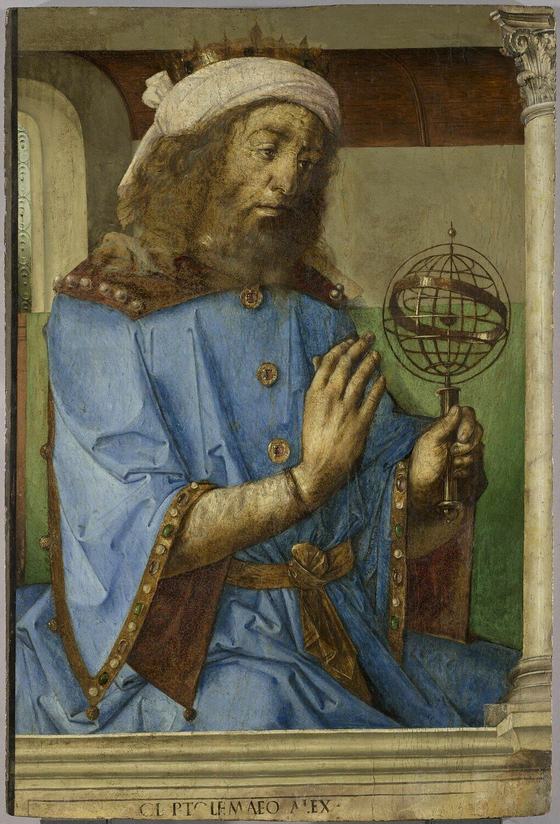
Claudius Ptolemy
c. 100 – 170 CE
- A Greco-Roman astronomer, mathematician and geographer living in Alexandria, Egypt.
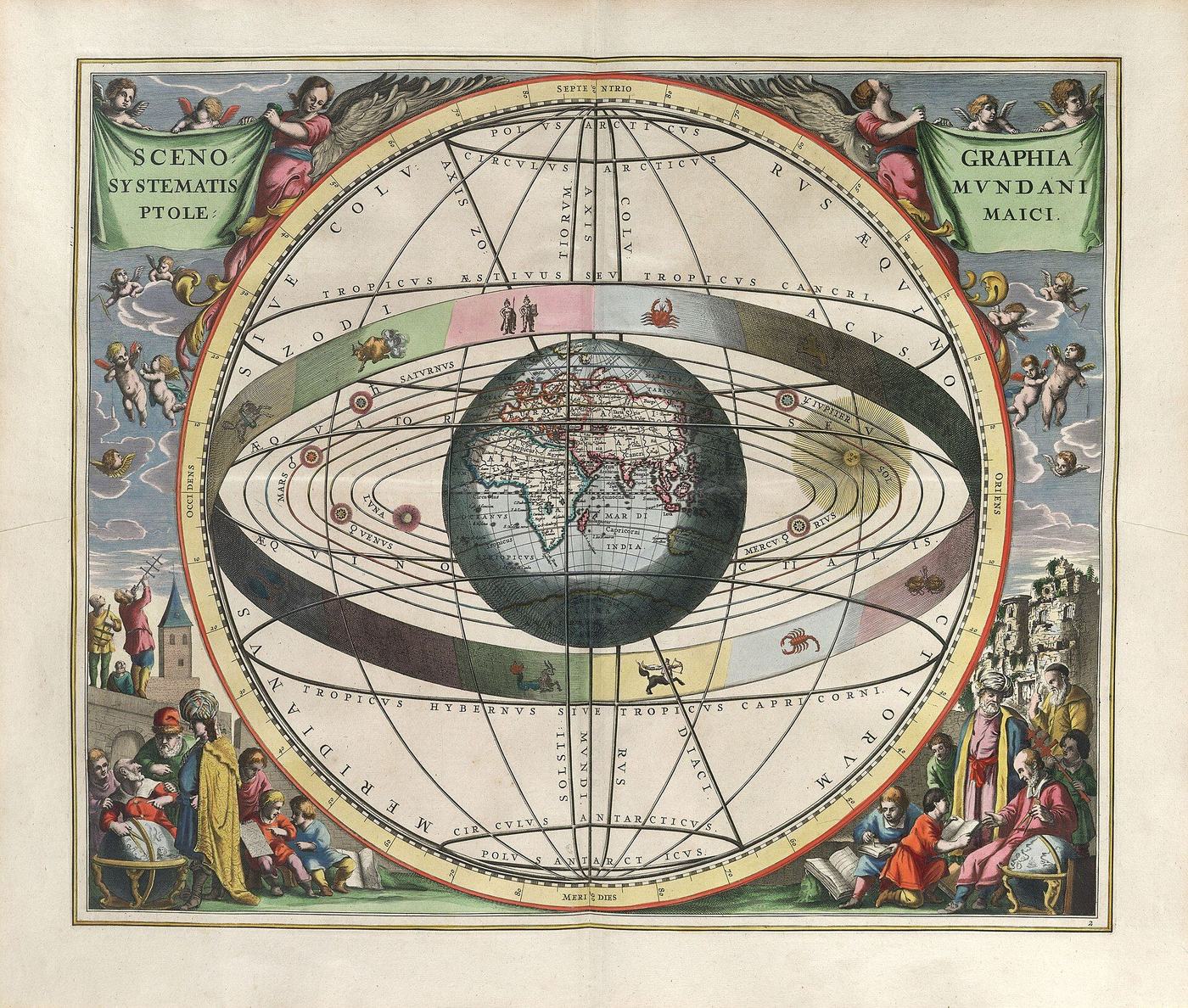
- Earth is the stationary center of the universe. Every celestial body orbits Earth.
- Planets move in small circles called epicycles, which ride along bigger circles (deferents) around Earth.
- His book, the Almagest, was the astronomy textbook of Europe and the Islamic world for over a thousand years.
follow the red trail. Mars stops, goes backwards, then forwards again. Epicycles were invented just to explain that loop.
- i.
Earth in the middle
It feels like the ground isn't moving. And if it were, wouldn't we be thrown off? Following Aristotle, Earth stayed put.
- ii.
Backward planets
Every couple of years Mars drifts backward across the stars for weeks (retrograde motion). A planet riding an epicycle reproduces this.
- iii.
Only perfect circles
The heavens were thought to be perfect, so every motion had to be built from perfect circles turning at steady speeds.
Chapter II 1543, Poland
Heliocentric Model
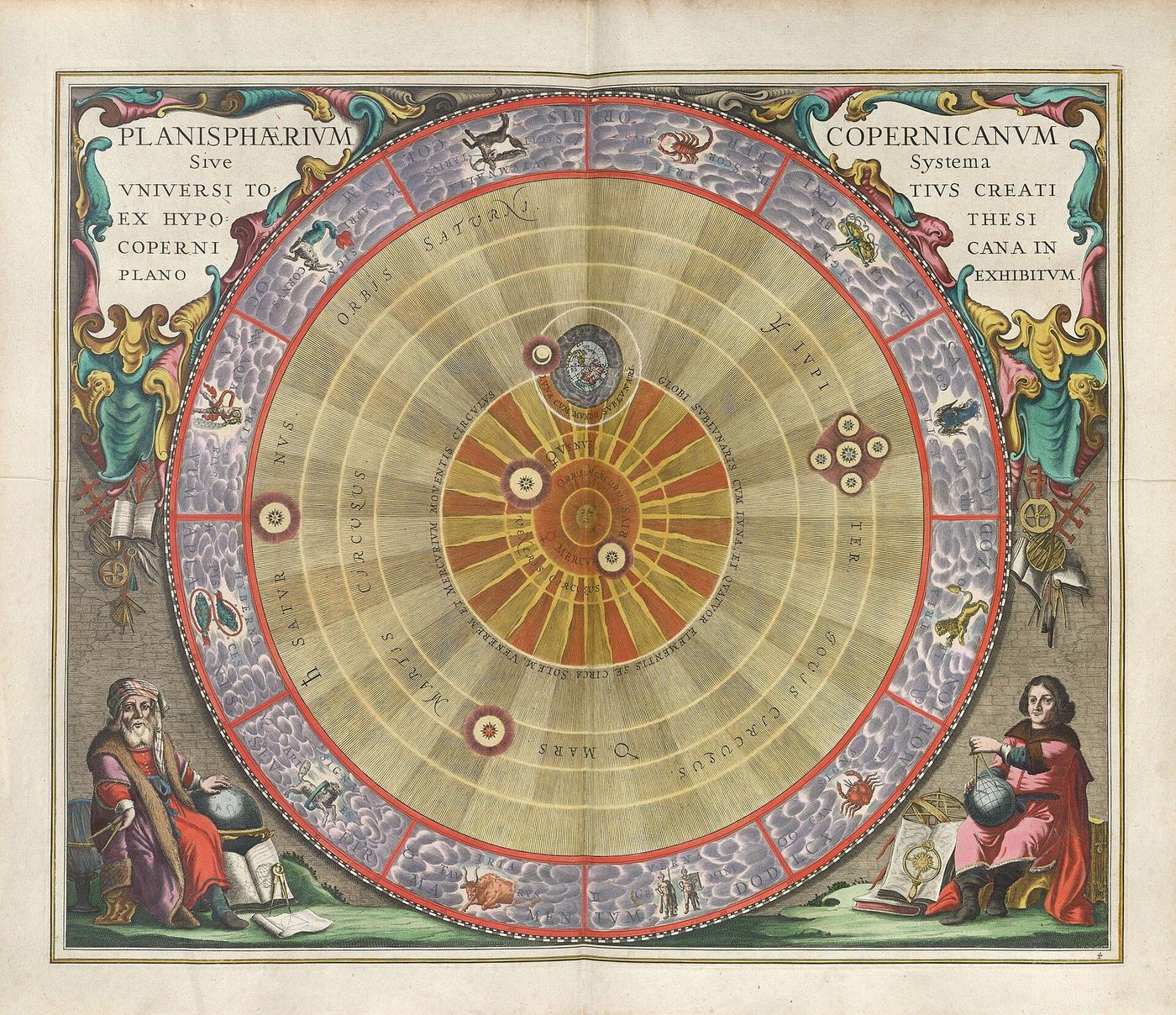
What if the Sun is in the middle instead? Suddenly the loops of Mars aren't strange at all. They're an illusion caused by our own moving planet.
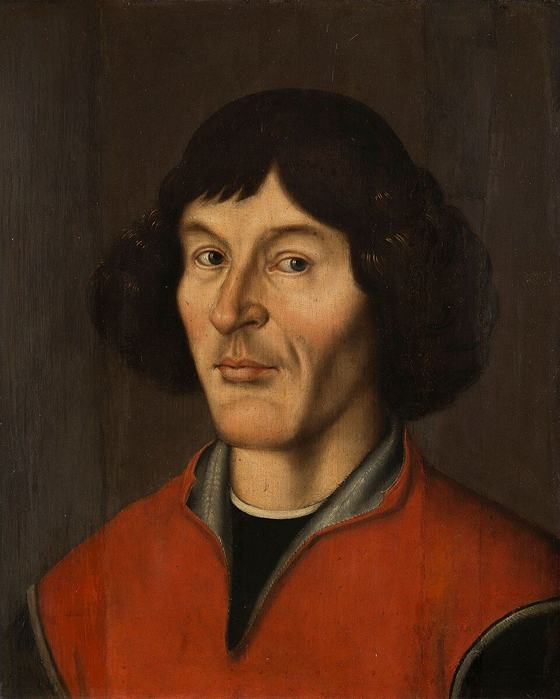
Nicholas Copernicus
1473 – 1543
- A Polish astronomer, mathematician and Catholic cleric.
- The Sun, not Earth, is the center of the solar system. Earth is just another planet.
- Earth spins on its axis once a day, giving us day and night, and circles the Sun once a year.
- His book On the Revolutions of the Heavenly Spheres was printed in 1543. Legend says he saw the first copy on the day he died.
the dashed line is where we see Mars against the stars. Watch the orange dots on the outer ring slide back as Earth overtakes Mars.
- i.
Sun-centered
Planets line up by distance from the Sun. The farther out a planet is, the longer its year.
- ii.
A spinning Earth
Sunrise and sunset happen because Earth turns once a day, not because the whole sky spins around us.
- iii.
Loops explained
Retrograde motion is just perspective: a faster inner planet passing a slower outer one, like overtaking a car on the highway.
Chapter III 1588, Denmark
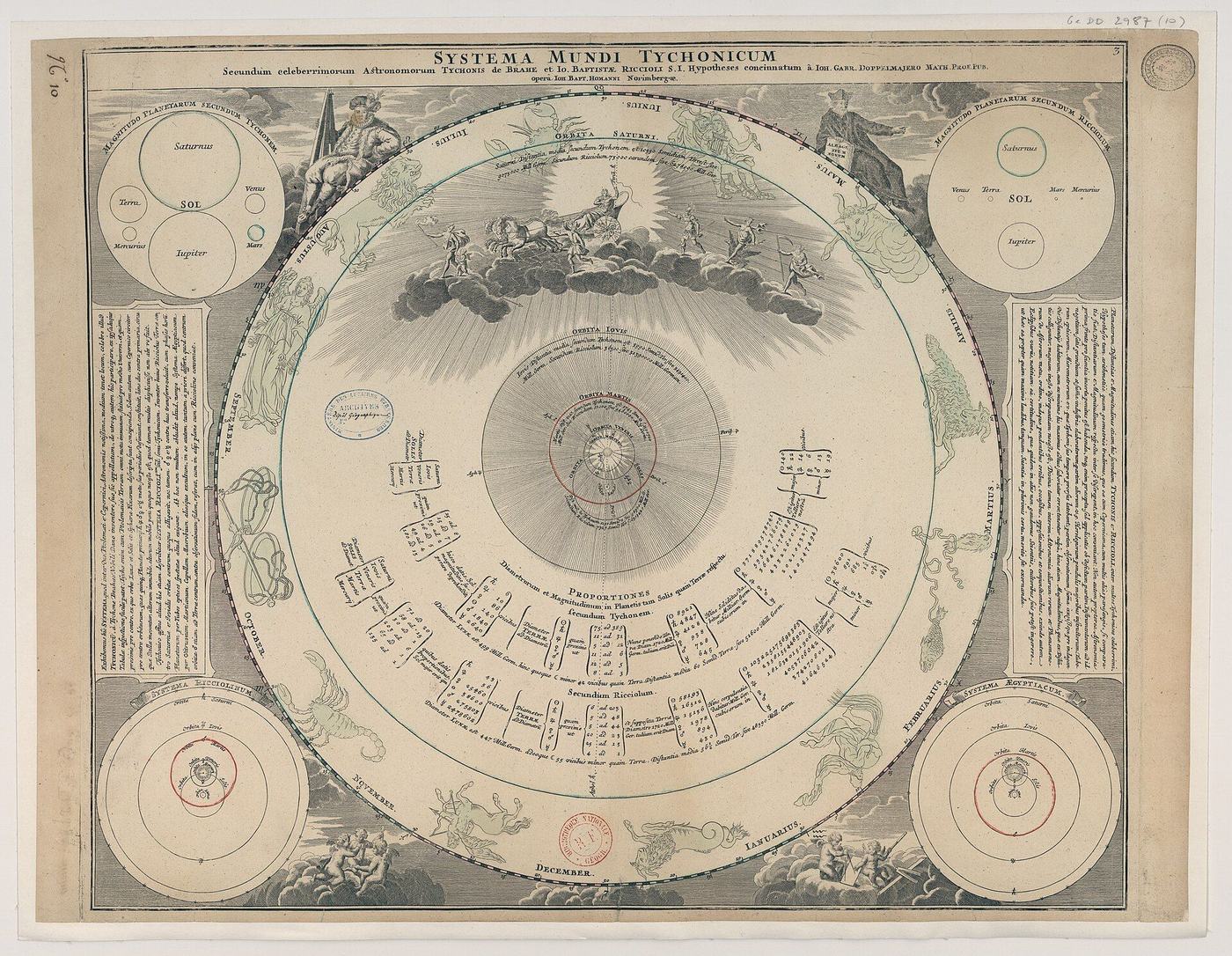
Geoheliocentric Tychonic Model
A compromise. Earth stays still in the middle and the Sun goes around it, but every other planet goes around the Sun.
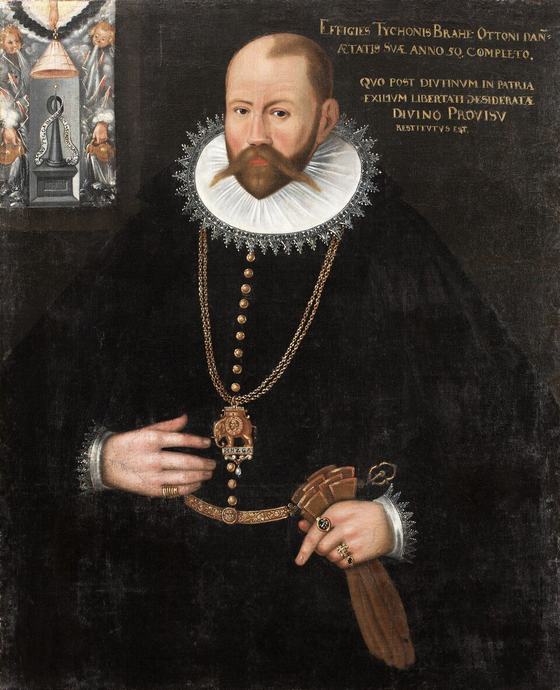
Tycho Brahe
1546 – 1601
- A Danish astronomer and nobleman known for his highly accurate observations.
- There were no telescopes yet, so he built huge instruments (quadrants and sextants) to make the most precise naked-eye measurements in history.
- He didn't fully believe Copernicus. In his model the Sun orbits Earth while all the other planets orbit the Sun.
- He recorded decades of careful data on planet positions. That data turned out to be the missing puzzle piece.
fun fact: Tycho lost part of his nose in a sword duel at age 20 and wore a metal replacement for the rest of his life.
Mars's orbit even crosses the Sun's path! Tycho was fine with that because he didn't believe in solid crystal spheres.
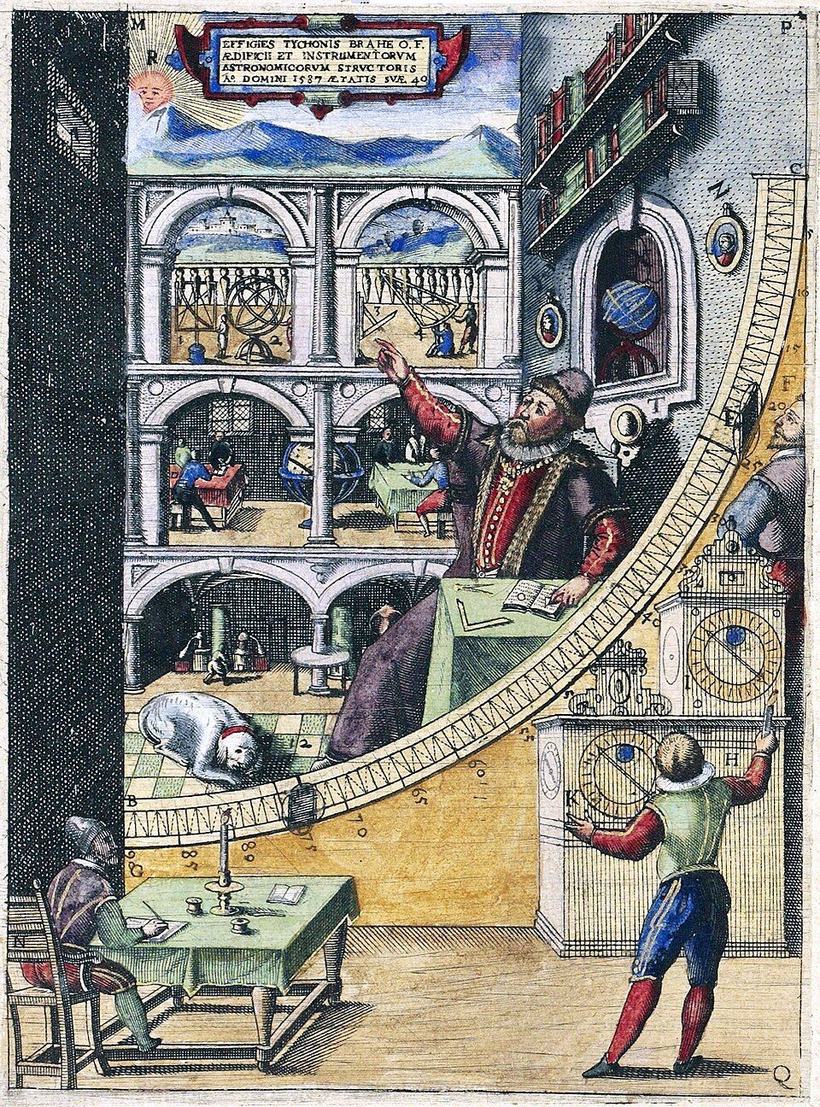
Measuring without a telescope
On the island of Hven, Tycho built Uraniborg, part castle and part observatory. Its brass quadrant was as big as a wall. With it he measured star positions to about 0 arcminute, roughly the width of a coin seen from 80 meters away.
He also proved that the new star of 1572 and the comet of 1577 were far beyond the Moon. So the heavens could change after all.
Chapter IV 1609 – 1610, Italy
Evidence Supporting Heliocentrism
Arguments weren't enough. Galileo pointed a brand-new invention, the telescope, at the night sky and found real evidence.
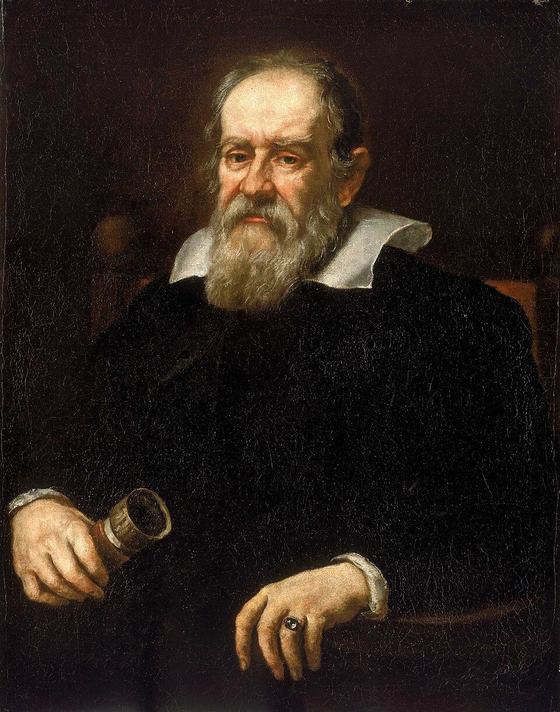
Galileo Galilei
1564 – 1642
- An Italian astronomer, physicist and engineer from Pisa.
- The first scientist to systematically use a telescope to study the heavens.
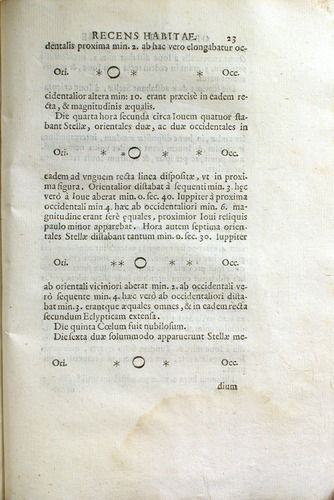
- Discovered Jupiter's four largest moons, proof that not everything orbits Earth.
- Watched Venus go through phases like the Moon, something Ptolemy's model can't produce.
The phases of Venus
This was the decisive test. Switch models and compare with what Galileo actually saw: a full cycle from thin crescent to almost full, with Venus looking smallest when it's fullest.
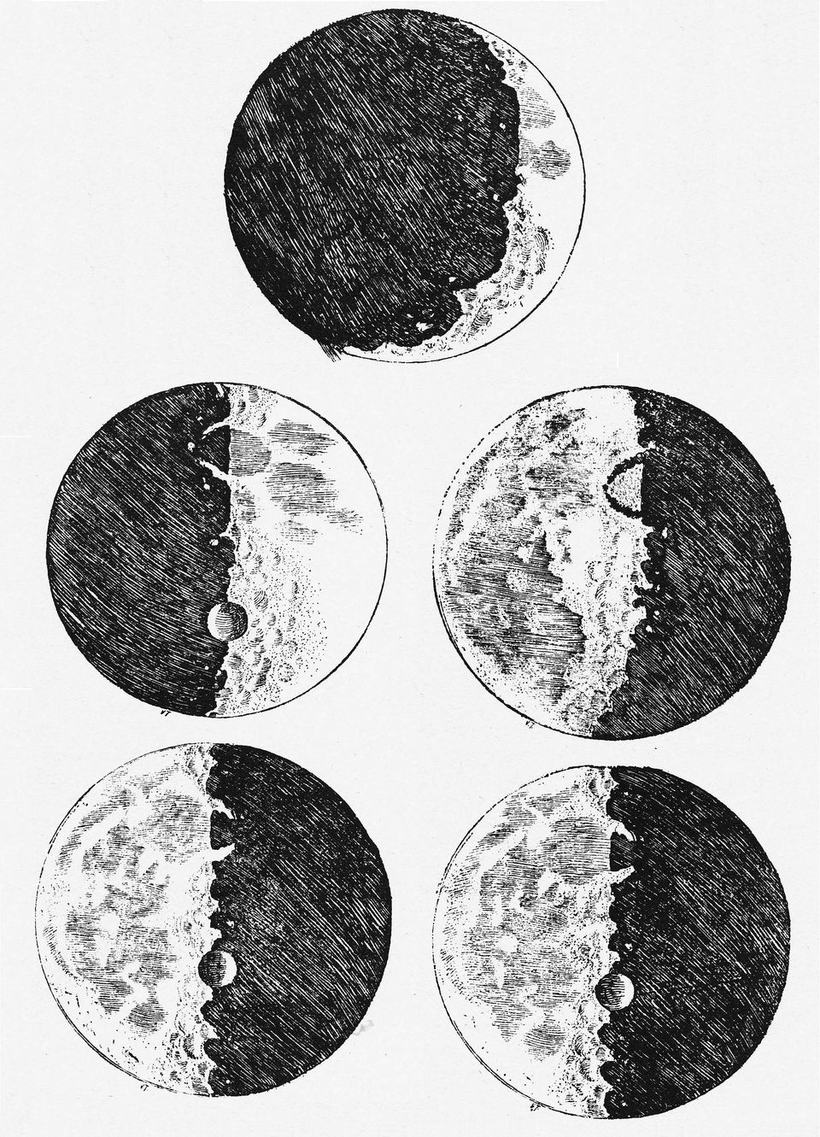
More cracks in the old sky
- i.
Mountains on the Moon
The Moon wasn't a smooth, perfect heavenly ball. It was rocky, with mountains and craters, a world a lot like ours.
- ii.
Spots on the Sun
Dark sunspots drifted across its face. The Sun had blemishes, and it rotated.
- iii.
Countless stars
The Milky Way broke up into stars too faint to see by eye. The universe was much bigger than anyone thought.
- iv.
The final proof came later
Stellar aberration (Bradley, 1729), stellar parallax (Bessel, 1838) and Foucault's pendulum (1851) finally showed directly that Earth moves.
Chapter V 1609 & 1619, Prague and Linz
Elliptical Heliocentric Model
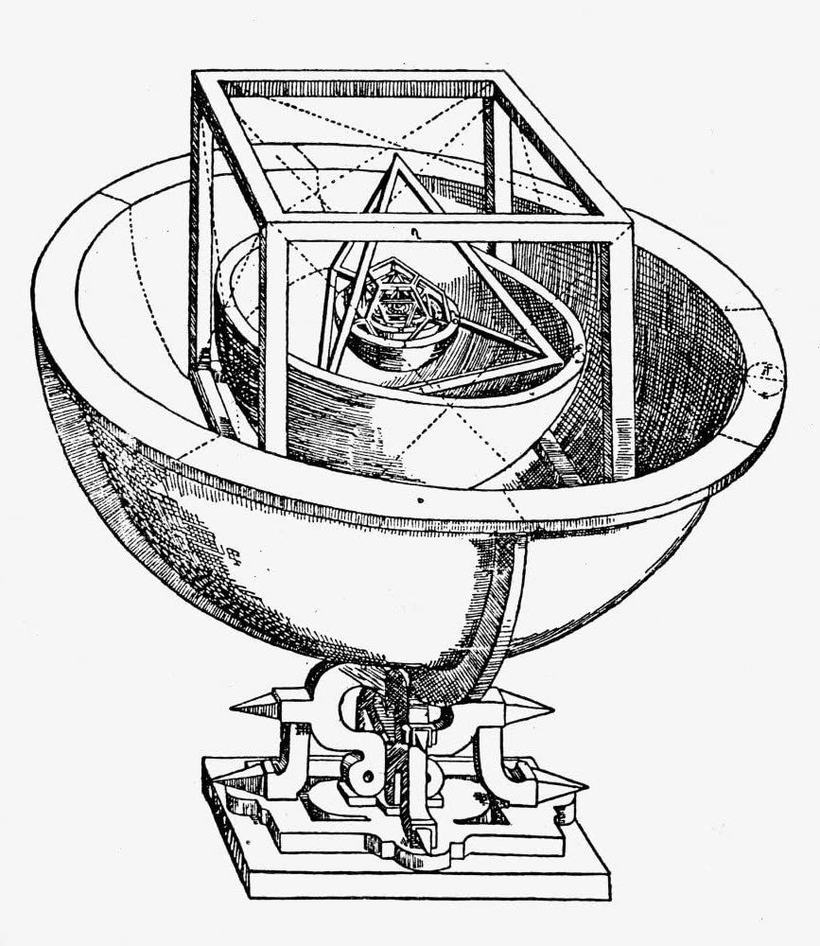
With decades of Tycho's data, Kepler threw out a 2,000-year-old assumption: that planets move in perfect circles.
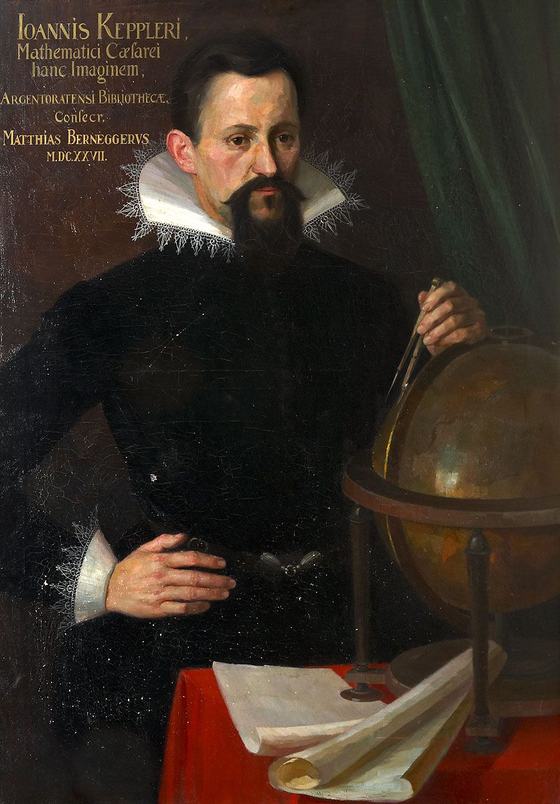
Johannes Kepler
1571 – 1630
- A German astronomer, mathematician and astrologer.
- Hired as Tycho Brahe's assistant, he inherited Tycho's mountains of observations when Tycho died.
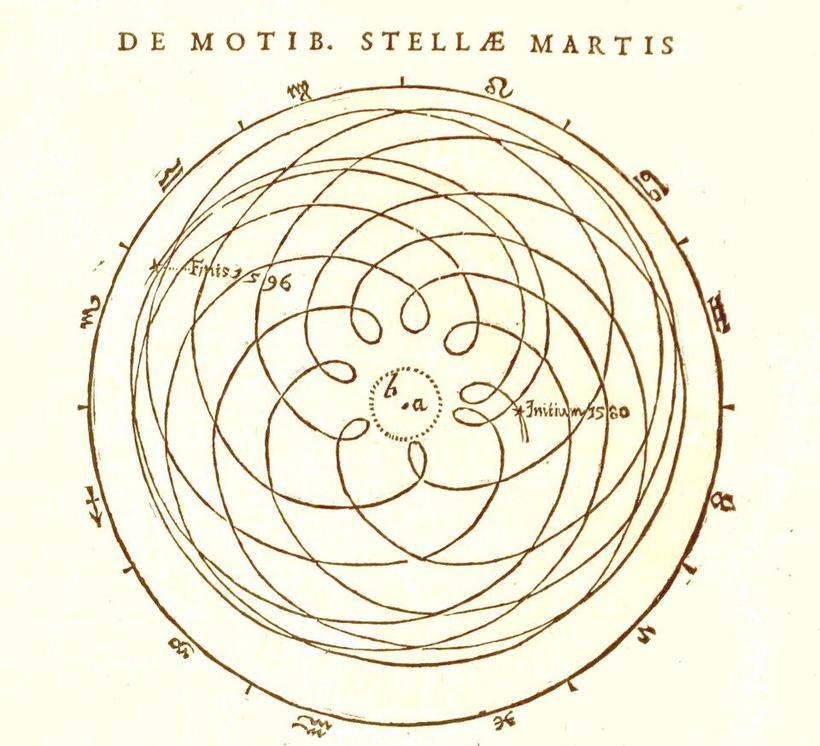
- He realised the math would never work with perfect circles. Orbits are "squished" circles: ellipses.
"Because these eight minutes could not be ignored, they alone have led the way to the complete reformation of astronomy."
Kepler, about a tiny 8-arcminute mismatch between circles and Tycho's data for Mars
Law of Ellipses
The orbit of every planet is an ellipse, with the Sun at one of the two foci.
- Perihelion: the point of the orbit closest to the Sun.
- Aphelion: the point farthest from the Sun.
- For every point on an ellipse, the distances to the two foci add up to the same number: d₁ + d₂ = constant.
- Eccentricity (e) tells how squished it is. 0 is a perfect circle; close to 1 is long and thin.
Law of Equal Areas
An imaginary line from the center of the Sun to the center of the planet sweeps out equal areas in equal intervals of time.
Think of a figure skater. When a spinning skater pulls their arms in, they spin faster. A planet does the same thing. Close to the Sun it speeds up, and far away it slows down (conservation of angular momentum).
Law of Harmonies
The ratio of the squares of the periods of two planets equals the ratio of the cubes of their semi-major axes.
- T is the orbital period in Earth years (1 year = 3.156 × 10⁷ s).
- r is the average distance in astronomical units (1 AU = 1.4957 × 10¹¹ m, the Earth–Sun distance).
| Planet | Period T (yr) | Avg. distance r (AU) | T² / r³ |
|---|
Every planet comes out at about 1.00. One simple rule ties the whole solar system together.
Chapter VI 1687, England
Universal Gravitation
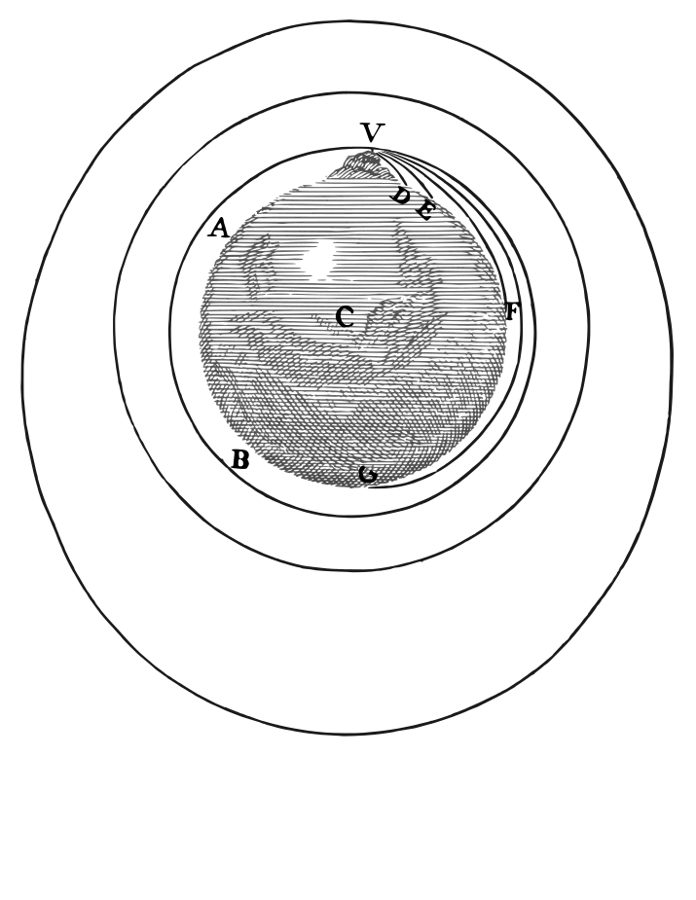
The force that makes an apple fall is the same force that holds the Moon in orbit, and the planets around the Sun.
Isaac Newton
1643 – 1727
- An English physicist, mathematician and astronomer.
- Kepler explained how planets moved. Newton figured out why.
- In the Principia (1687) he showed that one law of gravity plus his laws of motion produce all three of Kepler's laws.
G = 6.674 × 10⁻¹¹ N·m²/kg². Every mass attracts every other mass. Double the distance and the pull drops to ¼.
Why T² = r³
For a planet in orbit, gravity supplies exactly the centripetal force it needs to keep curving:
The constant 4π²/GM depends only on the Sun's mass, so it's the same for every planet. In years and AU it equals 1, which gives Kepler's T² = r³.
Earth pulls on the Moon with about 2 × 10²⁰ N, and the Moon pulls back on Earth just as hard (Newton's third law).
the whole story
The Domino Effect
Each idea knocked over the next. Take one domino out and the chain stops.
-
c. 150 CE→
Ptolemy → Copernicus
Ptolemy's Earth-centered model needed more and more epicycles. All that complexity pushed Copernicus to look for something simpler: put the Sun in the middle.
-
1543→
Copernicus → Brahe
Copernicus's idea had no proof and wasn't more accurate. Tycho set out to settle it with the most precise measurements ever made, and proposed his own hybrid model.
-
1588 – 1601→
Brahe → Kepler
Tycho's decades of data passed to his assistant Kepler. The numbers were precise enough to show that circles simply didn't work.
-
1610→
Galileo knocks out the old sky
Jupiter's moons and the phases of Venus were real evidence that not everything circles Earth. Ptolemy's model was finished, and the Sun-centered view gained support.
-
1609 – 1619→
Kepler → Newton
Kepler's three laws described how planets move: ellipses, equal areas, T² = r³. That was exactly the pattern Newton's theory had to explain.
-
1687
Newton explains why
Universal gravitation explained all of Kepler's laws with a single force. Falling apples, the Moon and the planets all follow one law of physics.